

Calm a Most Important Ingredient For a Beautiful State
Listen to the TAO TE CHING
Wu Wei
Dive Deeper
The Wisdom of Lao Tzu and the Tao
In a world obsessed with speed, success, and control, the ancient wisdom of Lao Tzu offers a radically different approach—one that invites flow, balance, and effortless harmony with life itself. This is the Way of the Tao.
Taoism isn’t about rules or rigid beliefs; it’s about alignment with nature, understanding the flow of life, and letting go of resistance. Lao Tzu, the legendary sage and author of the Tao Te Ching, taught that true power comes not from force, but from stillness. That wisdom isn’t found in struggle, but in surrender.
What Does It Mean to Live the Tao?
To live according to the Tao means to:
✅ Embrace simplicity – The less we chase, the more we receive.
✅ Trust the natural flow – Stop fighting the current; let the river carry you.
✅ Act without force (Wu Wei) – The most powerful actions are effortless.
✅ Cultivate stillness – Silence reveals truth more than endless thought.
✅ Lead with humility – True strength lies in softness and adaptability.
Living the Tao: A Deeper Dive into Lao Tzu’s Wisdom
The Tao, or “The Way,” is not something to be controlled, owned, or even fully understood. It simply is—like the wind that blows without effort, the river that flows without resistance, and the seasons that change without struggle. Lao Tzu’s teachings in the Tao Te Ching invite us to live in harmony with this natural flow of existence. But what does that really mean?
Let’s dive deeper into three key Taoist principles and how they can transform your life.
1. Wu Wei (Effortless Action)
The Power of Letting Go
One of the most misunderstood yet powerful concepts in Taoism is Wu Wei, often translated as “effortless action” or “action without force.”
🔹 It doesn’t mean doing nothing. It means acting in harmony with the moment.
🔹 It’s the difference between forcing a solution and allowing the right path to reveal itself.
🔹 Think of an athlete in the “zone”—they’re not overthinking, they’re flowing effortlessly.
💡 How to Practice Wu Wei:
- Stop forcing situations—observe, then act when the moment is right.
- Trust in timing rather than trying to control every outcome.
- Let go of attachment to rigid plans; be adaptable.
Example: Instead of pushing to make a relationship, career, or investment work, step back and observe where the energy flows naturally. You’ll often find a better path when you stop forcing the wrong one.
2. Simplicity & Spontaneity – The Art of Non-Resistance
Lao Tzu teaches: “The great Way is easy, yet people prefer the side paths.”
Society tells us we need more—more money, more success, more things. The Tao teaches us to simplify and trust in life’s unfolding.
🔹 A tree does not try to grow; it just does.
🔹 The sun does not force itself to shine; it simply rises.
🔹 Children laugh, play, and live freely—without overanalyzing.
💡 How to Live Simply & Spontaneously:
- Detach from excess. What in your life feels heavy? Release it.
- Follow joy. If something feels light and natural, move toward it.
- Stop overthinking. Your intuition often knows the answer before your mind does.
Example: Instead of overplanning every detail of your life, leave space for spontaneity. The best moments often come when we least expect them.
3. Water – The Ultimate Teacher of the Tao
Lao Tzu often uses water as the perfect metaphor for the Tao.
🌊 Water is soft, yet it wears down mountains.
🌊 Water adapts—it takes the shape of whatever it fills.
🌊 Water flows effortlessly to where it is needed most.
💡 How to Be Like Water:
- Be flexible—rigidity leads to breakage.
- Learn to yield instead of always resisting.
- Flow around obstacles instead of wasting energy fighting them.
Example: If a plan in your life isn’t working, instead of forcing it, adapt. Find another path. Water never gets stuck—it simply finds a new way forward.
Bruce Lee Taught "Be Like Water"
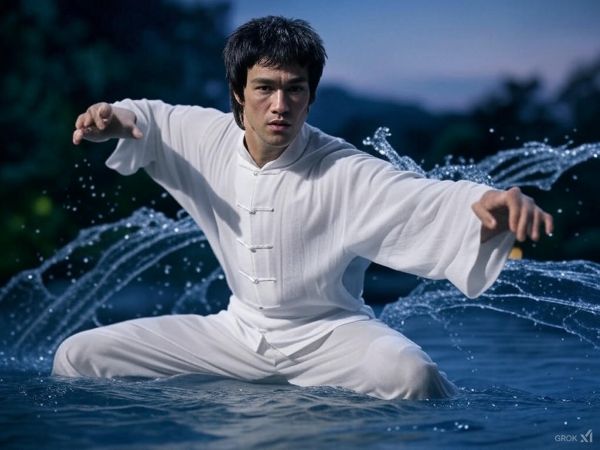
Bruce Lee & The Philosophy of “Be Like Water”
Bruce Lee wasn’t just a martial artist—he was a philosopher, a seeker of truth, and a master of adaptability. One of his most famous teachings is:
“Empty your mind. Be formless, shapeless—like water. You put water into a cup, it becomes the cup. You put water into a bottle, it becomes the bottle. You put it into a teapot, it becomes the teapot. Now water can flow, or it can crash. Be water, my friend.”
But what does it really mean to “be like water”, and how can we apply this philosophy in everyday life?
1. Adaptability: The Key to Growth
Bruce Lee believed that rigidity leads to failure. A tree that refuses to bend in the wind will eventually break, while one that sways with the storm survives.
💡 Application: Instead of resisting change, adapt. Whether in business, relationships, or personal growth, those who adjust quickly thrive.
👉 In your career: Industries evolve. Skills become outdated. Be willing to learn, pivot, and innovate rather than clinging to old ways.
👉 In personal struggles: Instead of fighting what you can’t control, flow around obstacles like water does around rock
2. Letting Go of Ego & Fixed Identity
Water doesn’t have a fixed form—it takes the shape of whatever holds it. This reflects non-attachment, a principle found in Taoism, which deeply influenced Bruce Lee.
💡 Application: Don’t be stuck in a fixed identity. Many people limit themselves by saying, “This is just who I am.” Growth happens when you allow yourself to change.
👉 In conflict: Instead of reacting with ego, stay fluid. Listen. Adjust. Find the best approach, not just the one that “feels right” in the moment.
👉 In self-improvement: Don’t box yourself in with labels. Stay open to becoming something greater than you were yesterday.
3. Flow, But Strike When Necessary
Water flows, but it also crashes. Bruce Lee’s martial arts weren’t about brute force—they were about knowing when to be soft and when to strike with precision.
💡 Application: In life, timing matters. Know when to go with the flow, and when to take decisive action.
👉 In decision-making: Sometimes patience is key. Other times, you must act immediately.
👉 In leadership: Great leaders listen and observe first, but when the time is right, they take bold action.
Final Thought: Are You Water?
Bruce Lee’s lesson is clear: Rigid things break. Water endures.
Next time you face an obstacle, ask yourself:
👉 Am I resisting, or am I adapting?
👉 Am I stuck in my ways, or am I flowing with life?
👉 Am I waiting for the right moment to strike?
Mastering the Tao: Living in True Harmony with the Way
Your Highest Achievement is Control of Your Thoughts and Feelings
Neville Goddart Quote